
Creation Series Volume Two
- J.P. Lagio
- December 30, 2025
Creation did not end with the Big Bang.
In this second installment of the Creation Series, J.P. Lagio explores the rhythms written into the universe itself—cycles of expansion, decay, and renewal that suggest creation is not a moment, but an ongoing act.
Introduction
In the first installment of the Creation Series, we asked whether belief in God still makes sense in a scientific age. Here, we turn our attention outward—to the universe itself—and ask a different question: if creation had a beginning, what does it look like as it unfolds?
This reflection explores the rhythms woven into existence—from stars and seasons to birth, death, and renewal—and what those patterns may reveal about the nature of creation and the mind behind it.
The Breath and Rhythm of Creation
Everything in creation moves in patterns. The sun rises and sets. The seasons turn. Life emerges, matures, fades, and gives way to life again. Nothing in nature stands still for long, and nothing grows forever without pause.
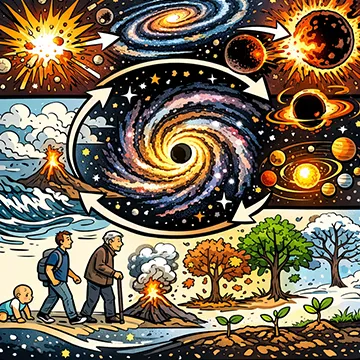
Even the universe itself seems to follow this rule. Born in a moment of unimaginable energy, it has spent billions of years expanding, cooling, and forming structure. Galaxies spin, stars ignite and collapse, and the heavy elements forged in stellar death become the building blocks of new worlds. Creation, it seems, is not static—it breathes.
Modern cosmology tells us that the universe is expanding, possibly accelerating. Whether that expansion will continue forever or someday slow and reverse remains uncertain. What is clear, however, is that motion, change, and transformation are written into the fabric of reality itself. The universe unfolds according to rhythms set at its beginning.
These rhythms echo everywhere we look. Forests grow, burn, and regenerate. Oceans rise and fall. Civilizations ascend and decline. Even our own bodies follow cycles—sleep and waking, health and illness, youth and age. Creation sustains itself through renewal, not permanence.
From a theological perspective, this rhythm does not replace a Creator—it reveals one. When I use the word God, I do not mean a distant overseer who intervenes occasionally. I mean the sustaining intelligence that continually gives existence its coherence. Creation is not something God did once; it is something God is still doing.
The universe, then, is less like a machine and more like a living system. Its laws do not merely enforce order; they allow for creativity, emergence, and beauty. Stars must die so planets can form. Old structures must collapse for new ones to arise. What appears as destruction is often preparation.
This pattern challenges our modern obsession with endless growth. We are conditioned to see decline as failure and rest as weakness. But creation teaches a different lesson: contraction is not the opposite of growth—it is part of it. Every inhale requires an exhale.
If the universe itself moves in rhythms, then perhaps meaning is found not in resisting change, but in learning to move with it. Creation is not rushing toward an end; it is unfolding according to a deeper logic—one that values balance over accumulation and renewal over control.
Seen this way, the universe becomes more than a backdrop for human life. It becomes a teacher. Its rhythms invite humility, patience, and trust. They remind us that life is not a straight line, but a living pulse—one that carries us forward by teaching us when to grow, when to release, and when to begin again.