
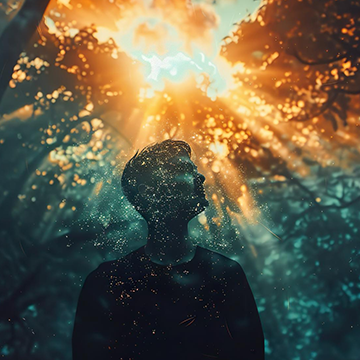
Creation Series — Volume Three
- J.P. Lagio
- February 10, 2026
If the universe breathes, then so do we.
In this third installment of the Creation Series, J.P. Lagio turns inward—exploring consciousness, soul, and why the part of us that knows may point beyond the body.
Introduction
In the first installment, we asked whether belief in God still makes sense. In the second, we explored creation as an ongoing, rhythmic process written into the universe itself. Now the focus narrows—from the cosmos to the self.
This reflection considers consciousness—the strange, luminous fact that we are aware at all—and asks whether that awareness is merely biological, or whether it reveals something deeper about who we are and how we participate in creation.
Echoes of the Eternal
If the universe breathes, then so do we. Not just physically, but inwardly—through awareness itself. We are not only alive; we know that we are alive. That single fact separates us from everything else we observe and places us in a strange position within creation: part of it, yet able to reflect upon it.
Science can describe the brain in remarkable detail. It can trace neural pathways, measure electrical impulses, and explain how injury alters personality. But no scan has ever located the experience of being—the feeling of love, the sting of regret, the quiet certainty of selfhood. There remains a gap between matter and meaning that refuses to close.
This gap has a name: consciousness. And despite centuries of inquiry, it remains one of the deepest mysteries in science and philosophy. We know that consciousness correlates with the brain, but correlation is not origin. A radio depends on its circuitry, yet the signal it receives is not generated by the radio itself.
If consciousness is not reducible to matter, then it may be fundamental rather than accidental—something woven into reality itself. That possibility aligns naturally with the idea of God as the sustaining intelligence behind existence. If mind precedes matter at the cosmic level, then human consciousness becomes less of an anomaly and more of an echo.
Across cultures and centuries, people have intuited this truth. The soul, the spark, the breath—different names for the same insight: that something within us participates in something eternal. This is not superstition born of fear, but reflection born of awareness. We sense that the self is more than biology because we experience it as such.
The question of survival beyond death naturally follows. If consciousness is produced entirely by the brain, then death is the end of the story. But if consciousness is received rather than generated—filtered through the body rather than created by it—then death may represent not annihilation, but release.
This does not require certainty to be meaningful. It requires coherence. A universe grounded in mind, unfolding through rhythm, would reasonably give rise to beings whose awareness is not extinguished when form dissolves. The wave returns to the ocean, but the ocean remains.
What, then, is our role? Perhaps it is not to escape creation, but to participate consciously in it. To carry awareness, compassion, and memory through time—and, in doing so, to add depth to existence itself. Each human life becomes a lens through which the universe knows itself.
In that sense, consciousness is not a byproduct of creation. It is its mirror. The eternal does not merely surround us; it looks out from within us. We are not strangers in the universe—we are echoes of it, listening for the source of the sound.